HOTLINE: 0908 340 239
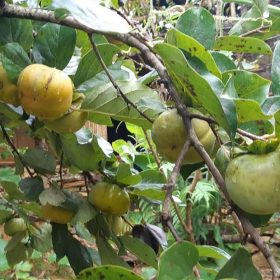
The new persimmon variety belongs to the non-astringent group, also known as the crisp persimmon (named Fuyu), originating from Japan. The fruit is flattened, slightly square, turning yellowish-orange when ripe, with bright yellow, crunchy, non-astringent flesh. Because the fruit is firm, it is easier to transport and can be stored much longer than local astringent persimmon varieties.
Farmers use scions of this persimmon variety grafted onto local rootstock. The trees grow and develop well, yielding abundant fruit. Notably, when ripe, the fruit does not require soaking or traditional astringency removal methods; it can be picked directly from the tree and eaten immediately without any astringent taste.
Below are the technical guidelines for growing and caring for crisp persimmons provided by engineer Dang Dinh Thang from the Plant Protection Research Institute.
In northern provinces, regions with an altitude of over 300 meters above sea level are generally suitable for growing persimmons.
However, to produce high-quality persimmon fruit, it is recommended to plant them in areas with an altitude of over 500 meters. The soil should have a cultivation layer thickness of 70 cm and a low groundwater table. pH level: 4.5 – 6. If the soil is too acidic (low pH), agricultural lime should be used to raise it. Major crisp persimmon growing regions currently concentrate in Hoa Binh and Son La.
Location: Orchard blocks are best arranged next to or near water sources to ensure active irrigation during droughts, equipped with drainage ditches to prevent waterlogging during the rainy season and floods.
Orientation: Plant in a North-South direction. This ensures optimal spacing between trees so they do not block each other's light, facilitating good photosynthesis and lateral branch development.
Sloping Terrain: When establishing an orchard on sloping land, construct terrace beds 3 – 5 meters wide following contour lines.
Interplanting Pollinizers: Engineer Dang Dinh Thang recommends planting both pollen-producing varieties (astringent persimmons) and commercial local varieties (non-astringent persimmons). Planting exclusively crisp persimmons leads to very poor fruit set, particularly during unfavorable weather conditions such as high soil moisture, which causes massive fruit drop.
Ratio: 1:10 (1 astringent persimmon tree for every 10 non-astringent crisp persimmon trees).
After designing the orchard, dig planting holes:
Garden soil: Dig holes 50 – 60 cm deep and 60 – 70 cm wide.
Hill soil: Dig holes 60 – 80 cm deep and 80 – 100 cm wide.
To ensure healthy tree development, apply basal fertilizer before planting according to the following standards:
| Soil Type | Manure (kg/hole) | Lime Powder (kg) | Potassium (kg) | Micro-biological Fertilizer (kg) | Urea (kg) |
| Garden Soil | 30 – 35 | 0.2 | 0.2 | 0.5 – 1 | 0.1 |
| Hill Soil | 35 – 50 | 0.5 | 0.2 | 1 | 1 |
Planting Season: Best done in November and December (solar calendar) during the tree’s dormant period.
Standard Sapling Selection: After one year, the rootstock should have a diameter of 1.5 – 2 cm and the grafted shoot section should be 20 – 25 cm tall or more.
Planting Density:
Medium Intensive Farming (Funnel-shaped canopy):
Garden soil: 400 trees/ha (Row-to-row: 5m, Tree-to-tree: 5m).
Hill soil: 500 trees/ha (Row-to-row: 5m, Tree-to-tree: 4m).
High Intensive Farming (Fan-shaped or Y-shaped canopy with wire support systems): 800 – 1,000 trees/ha (2.5 – 3 × 5 m).
Post-Planting Care: Water immediately after planting. To protect trees from swaying in wind and storms, secure them with small bamboo stakes. Use straw, grass, or available organic residue to mulch around the base to retain moisture, suppress weeds, prevent runoff, and avoid soil erosion during heavy rains.
Intercropping: In the first one to two years before the canopies close, leguminous crops or vegetables can be planted between the rows. These crops retain soil moisture, increase fertility, and provide additional income.
| Tree Age | N (kg/ha) | P₂O₅ (kg/ha) | K₂O (kg/ha) |
| Under 5 years | 35 | 20 | 30 |
| 6 – 10 years | 100 | 60 | 80 |
| 11 – 20 years | 200 | 120 | 160 |
| Over 20 years | 265 | 160 | 210 |
Application 1: Apply 2/3 of the annual fertilizer amount from late December to January of the following year.
Application 2: Apply the remaining 1/3 in July – August.
Method: Apply at a depth of 5 – 10 cm around the canopy perimeter, then cover with soil.
Manure: Apply 25 – 30 kg/tree as a supplementary dose every 2 – 3 years during late winter.
Weed strictly inside the canopy zone, while allowing grass outside the canopy to grow 10 – 15 cm high to retain moisture and prevent soil erosion.
During years with low spring rainfall or drought, ensure adequate irrigation, especially during flowering and flushing periods.
Pruning ensures good light penetration and air circulation across the canopy, improving photosynthesis and simplifying pest management.
Basic Training Phase (6 months – 1 year after planting): When the tree reaches 50 cm, pinch the growing tip to initiate primary framework branches. Once primary branches grow 40 – 45 cm outward in all directions, cut them back to generate secondary branches.
Timing: Best pruned in late winter and spring. During production, prune in both winter and summer.
Canopy Styles: Funnel, Y-shape, and fan-shaped. The funnel shape is the easiest to prune and offers stable yields.
Funnel Canopy Technique: Maintain a single main trunk at 0.5 m, then top it. Leave 3 – 4 primary branches distributed evenly. Restrict primary branches to a maximum length of 45 cm to induce secondary branches. Keep 4 – 6 secondary branches distributed across two sides. Make clean 45-degree angle slanting cuts with pruning shears to prevent pathogen entry during rainy weather.
Remove weak, clustered, dead, or water-sprouting branches, maintaining the structured canopy shape. Cut back overly long horizontal branches (under 60 cm for funnel-shaped, under 40 cm for fan-shaped).
Note on Fruiting Wood: Persimmon fruits are borne exclusively on mother branches that grew during the previous year, specifically at the first to third bud from the tip downward. When cutting back portions of spent fruit-bearing wood, leave one to two buds. These buds will grow into mother branches that bear flowers and fruit the following year.
Timing: Perform once a year during winter dormancy.
Leaf-eating caterpillars: Damage crisp persimmons mainly in late spring and early summer (April – June), heavily impacting young trees during the basic construction phase by devouring young buds and foliage, which can stunt or kill plants.
Beetles: Appear in summer, damaging shoots and leaves, posing a severe threat to orchards near forest edges.
Control for leaf-eating insects and beetles: Spray with insecticides such as Sherpa or Fastax following recommended concentrations.
Fruit flies: Attack fruit pulp, causing fruit drop and severely hurting yield and quality.
Control for fruit flies: Practice proper pruning for open canopies and minimal water sprouts; harvest fruit promptly; collect and deeply bury all dropped fruit in the orchard.
Fungal Diseases (Angular leaf spot and circular spot): Typically emerge during high-rainfall months (July, August, September).
Prevention: Maintain healthy tree vigor, regularly inspect orchards, and gather diseased branches into a centralized area for disposal. If infections persist despite cultural practices, spray with Kepanlazin, Bavectin, Dithan, or Bordeaux mixture following manufacturer instructions.
Crisp persimmon provides high nutritional and economic value. Trees begin bearing fruit after 3.5 – 4.5 years, yielding approximately 20 – 50 kg per tree. At an average selling price of 20,000 VND/kg, after deducting expenses, farmers can net a profit of 250 – 300 million VND/hectare, with higher yields expected in subsequent years under proper care.
 Zalo
Zalo