HOTLINE: 0908 340 239
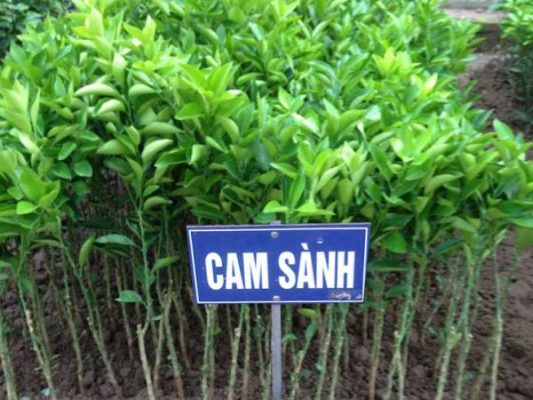
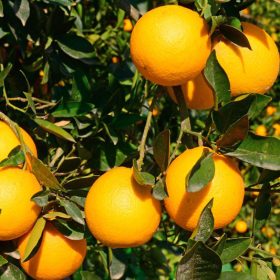
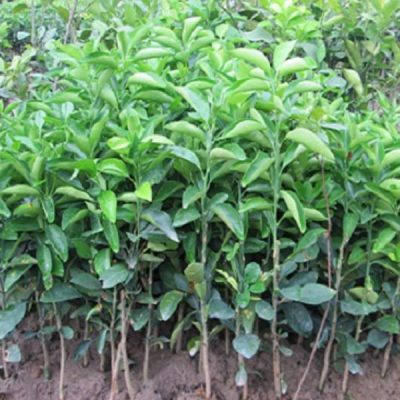
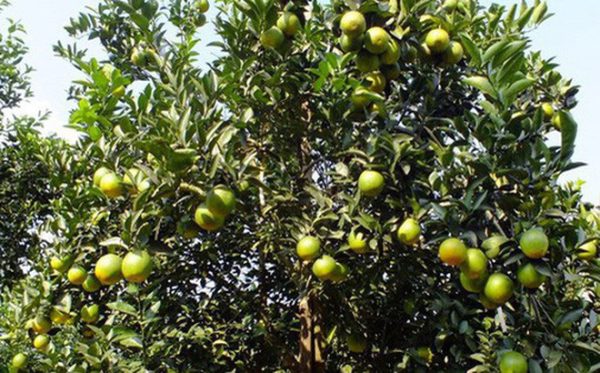
The Sành orange sapling (cây giống cam sành) produces oblate, roundish fruits with a deep yellow skin. The flesh is juicy and chewy, offering a sweet and sour flavor, with an average weight of 275 grams per fruit, making it highly popular among consumers. Today, by applying simple off-season Sành orange cultivation techniques, many farmers have achieved successful results and secured incomes 3 to 5 times higher than the main season. The commercial exploitation cycle spans 10 to 15 years. Off-season Sành oranges are suitable for fresh consumption, processing, and domestic distribution. Select grafted saplings that meet planting standards, are true to variety, measure 60–80 cm, and feature lush green foliage free of yellow leaves, pests, and diseases.
Selecting good, disease-free planting stock ensures vigorous growth during the foundational phase, enhances pest and disease resistance, and yields high-quality fruit. Saplings must be robust, plump, free of disease pathogens, and possess a healthy root system. For grafted trees, the stem diameter measured 3 cm above the graft union should exceed 0.5 cm, with a height of over 30 cm; for layered trees, the stem diameter should be greater than 0.8–1 cm.
Season: Oranges are best planted at the beginning of the rainy season (February) or at the end of the rainy season (September).
Spacing: Depending on soil and climate conditions, spacing can be set at 5 x 4m, 4 x 4m, or 3 x 4m.
Soil Preparation: The planting land must be elevated and equipped with good drainage systems to prevent seasonal flooding. In lowland and depression areas, dig ditches and build raised beds. In midland and mountainous regions, ensure an accessible water source for irrigation during dry spells.
Pit Digging: Dig planting pits with dimensions of 60 x 60 x 50 cm.
Before planting, apply fertilizer to the pits to provide plants with adequate nutrition.
Basal mix: 30–40 kg of well-rotted organic manure + 0.3–0.5 kg of superphosphate + 0.1–0.2 kg of potassium + 0.5–1 kg of agricultural lime + 0.1 kg of powdered insecticide (e.g., Basudin 10H).
Application method: Mix all ingredients thoroughly, fill the pit with the treated soil, and pour water into it. 10 to 15 days later, apply powdered insecticide onto the pit surface for optimal pest prevention.
Dig pits one month prior to planting. Excavate a small hole in the center of the pre-filled pit to accommodate the root ball, then pack the soil firmly around it.
Insert an X-shaped cross-stake and tie the plant securely to prevent the base from shaking, which could cause plant death.
Cover the base with organic mulch or dried grass and water thoroughly at least once a day until the plant recovers and resumes growth. Continue adjusting watering based on growth and weather conditions (paying special attention during the first 30 days post-planting).
Note: While young and prior to canopy closure, interplant legumes around the trees to utilize land, suppress weeds, and serve as green manure to improve the soil.
Watering: Provide sufficient water, especially during dry spells, fruit enlargement stages, and right before ripening.
Weed Control: Mulch the base with grass, debris, or green manure crops to suppress weeds. Break surface crusts (phá váng) after heavy rains. Perform thorough weeding once per season during spring (January–February) and autumn (August–September), cultivating the entire area 2–3 times a year.
Cut away vigorous overhead shoots (cành vượt), rootstock-derived suckers, diseased branches, and broken limbs. Retain necessary branches to maintain an even, balanced canopy.
Pruning and shaping begin when trees reach 0.5–0.6 meters in height to establish a sturdy framework, distributing branches in a star-like pattern along the trunk to prevent mutual shading. Older, exhausted branches that have finished bearing fruit should be pruned out to encourage young shoots for subsequent years' yields.
Windbreaks: Plant windbreaks to reduce evaporation, minimize friction between fruits and branches, and slow down insect migration—especially aphids and citrus psyllids. Windbreaks are planted along prevailing wind directions, at least 5 meters away from the first row of orange trees to avoid nutritional competition. Suitable windbreak species include Acacia auriculiformis (keo tai tượng), Acacia mangium (keo lá tràm), and Leucaena leucocephala (keo dậu).
Initial Recovery: One month after recovery, apply diluted pig manure or fermented urine (diluted 10 times with water) or 1% nitrogen fertilizer, applying every 15–20 days.
Foundational Phase (Years 1–3): Fertilizer per tree: 10 kg organic manure + 100g urea + 300g superphosphate + 100g potassium.
September & November: Apply 100% organic + 100% phosphate.
January 15 to March 15: Apply 40% urea + 40% potassium (to stimulate spring shoots).
May: Apply 30% urea + 30% potassium.
July–August: Apply 30% urea + 30% potassium (to stimulate autumn shoots).
Productive Phase (Year 3 onward):
In November, restrict watering and use a spade or hoe to dig a trench around the base, 25–30 cm away from the trunk. Sever surrounding roots and expose the base for 10–15 days to stress the tree until leaves turn slightly yellowish and wilted. Then apply 10–40 kg of well-rotted manure + 0.5–1 kg of superphosphate per tree around the canopy and cover with soil.
Note: Use sharp tools when root-pruning to avoid fraying, crushing, or shaking the base, which damages the tree. Water to maintain moisture afterward. Avoid disturbing the root zone during flowering and fruiting to protect blossom and fruit set rates.
Once fruit is established, apply fermented manure or soybean meal (1 kg/base soaked for 10–15 days), dilute 5 times, and water the trees every 20–25 days. Spread the remaining solids evenly around the canopy and lightly cover with soil. Foliar fertilizers can also be sprayed at recommended concentrations in March, May, June, and August while maintaining consistent soil moisture.
a. Leaf Miners (Sâu vẽ bùa): Active year-round, peaking from April to October.
Control: Spray new flush 1–2 times using products such as Sumisizin (0.1%), Decis (0.1%), Sherpa (0.1%), Padan (0.1–0.2%), Nicotex, or Supracide (0.1–0.2%).
b. Red Spider Mites (Nhện đỏ): Active year-round, peaking in winter and spring, attacking young foliage and fruits.
Control: Spray lime-sulfur (Summer-Autumn: 0.2–0.3°Bé, Spring: 0.5–1°Bé), Kentan (0.1%), Danitol-S 50EC (1%), Monocrotophos 56% (0.1–0.2%), or Methamidophos 600 (0.2%).
c. Stem Borers (Sâu đục cành): Active in May and June. Severe infestations over 2–3 consecutive years lead to tree death.
Control: Use nets to catch adults during emergence. Wrap trunks and large branches tightly with straw soaked in Ofatox (0.1%) to kill wood-borers upon contact. For larvae, use a syringe to inject Ofatox or Sumisizin (1/200 or 1/100) or Monito (0.2%) into larval tunnels, then seal holes with clay.
d. Citrus Psyllids (Rầy chổng cánh): Vectors of citrus greening disease (huanglongbing), a severe citrus threat.
Control: Spray Bassa 50EC (0.2%), Applaud-Mipcin (0.2%), or Shrezol (0.2%) during new flush cycles, applying twice per flush (first at bud break, second at full flush emergence).
e. Fruit Flies (Ruồi đục quả): Primarily managed using bait traps. Apply diluted Methyl Eugenol combined with Nales 5% onto cut fruit surfaces or bait stations to attract and kill males; alternatively, spray Dipterex (0.05%).
f. Citrus Canker (Bệnh loét): Caused by the bacterium Xanthomonas citri, affecting leaves, branches, fruits, and thorns. Severe leaf infection causes defoliation, while infected fruits largely rot.
Control: Sanitize nurseries and orchards; prune and burn diseased branches. Control leaf miners during summer months to prevent bacterial entry through larval wounds. Spray Bordeaux mixture (1%), Zineb (0.5–1%), or Casuran (1%).
Timing: Harvest when 20–30% of the skin color transitions from green to yellow. Harvest during cool, shaded days to support proper subsequent flower bud differentiation.
Technique: Use dedicated shears to cut fruit stems gently, avoiding mechanical injury. Place fruits into crates or baskets lined with paper or foam, transport them to a collection point, sort, dry the skin, and proceed with storage preservation.
Storage in Wooden Crates Lined with Dry Banana Leaves: Select unbruised fruits of uniform size, wash with clear lime water, let dry for 5–7 days, apply lime to the fruit stems, place in the middle of a crate while layering with dry banana leaves between fruits, and seal tightly against wind.
Storage in Perforated Nylon Bags: Select unbruised fruits of uniform size, wash with clear lime water, let dry for 5–7 days, apply lime to the fruit stems, place into perforated nylon bags, and store in a cool, ventilated place.
 Zalo
Zalo