HOTLINE: 0908 340 239
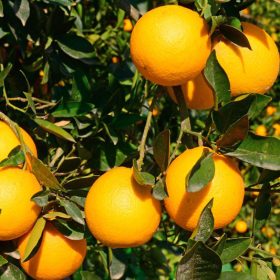
The red-fleshed Cara Cara orange, also known as the Australian red-fleshed navel orange or seedless red-fleshed orange, is the Cara Cara Navel N02 variety trial-cultivated in Bao Loc, Lam Dong, by Agricultural Engineer Mai Viet Phuong, a Vietnamese-Australian agronomist who tested it from the original Cara Navel N02 variety.
Tree Growth: A 3-year-old tree reaches an average height of 2.2 meters, with an average canopy spread of 2.3 meters.
Yield and Fruit Size: Trees bear trial fruit after 2 years of planting and yield their first harvest starting in year 3, averaging 60 to 85 fruits per tree (roughly 72 fruits). The fruits are large, slightly oval, weighing between 180 and 235 grams (average 217 grams), with a rind thickness of 3.1 mm and a characteristic navel bulge at the bottom.
Flavor and Quality: When ripe, the rind is smooth, deep orange, very attractive, and easy to peel and separate into segments. It has a pleasant aroma, a rich, sweet taste, and lower acidity than domestic varieties.
Nutritional Value: Navel oranges are the world's most popular fresh-eating citrus. Specifically, the N.02 variety features red flesh and juice due to its high lycopene content (around 3.p ppm), which offers powerful cancer-preventive properties.
Seedlessness: The pollen sacs of Navel N.02 are largely empty with no pollen, resulting in completely seedless fruit when grown in isolation or inside greenhouses. Even when interplanted with other fertile varieties, Navel N.02 remains virtually seedless (0 to 1-2 seeds), proving its female sterility. It is an early-ripening variety, harvested from early September to November in trial locations.
Economic Value: Although yields are lower than the control Xa Doai variety (8 tons/hectare in the 4th year post-planting), its high quality and early harvest—occurring when other oranges are not yet ripe—allow it to command high market prices (averaging 25,000 to 30,000 VND/kg), delivering economic efficiency 3 to 4 times higher than local varieties.
Disadvantages: The main drawback is its susceptibility to fruit drop caused by high humidity, especially during the rainy season. When foliage develops vigorously, the tree is highly sensitive to citrus canker.
Overall, the tree grows and develops well, producing exceptional fruit quality. Scientists and managers initially evaluate the seedless red-fleshed Cara Cara Navel (N.02) as highly adaptable to test ecological regions, representing a top-quality, early-ripening, seedless citrus option with excellent off-season crop distribution potential.
Suitable locations include rolling hills or sloped alluvial soils with high fertility, deep topsoil layers, loose structure, and good drainage. Waterlogged, compacted, or shallow soils are unsuitable.
Season: April to September.
Pit Dimensions: 40 x 40 x 40 cm. Spacing should be 4 meters between trees and 4 meters between rows. Interplanting with guava is recommended during cultivation to deter Diaphorina psyllids from transmitting citrus greening disease, as guava leaves contain essential oils that repel these pests.
Planting Technique: Dig a small hole in the center of the pre-filled pit that is deeper and wider than the sapling's root ball. Place the sapling straight, fill soil 3 to 5 cm higher than the root ball, pack firmly, and water.
Moisture Management: Water daily immediately after planting to maintain 70% soil moisture. Afterward, depending on soil moisture, water every 3 to 5 days. Use ground plastic mulch to suppress weeds and pests. In prolonged dry spells, apply mulch around the base using straw or leaves to retain moisture.
Fertilization:
Basal Fertilizer: 10 kg of organic manure + 0.5 kg of superphosphate + 0.5 kg of agricultural lime per pit, applied 15-20 days before planting. Mix thoroughly with top and middle soil layers, place bottom soil back, layer with mixed fertilizer and soil, shape the pit, and dust lime over a thin 2-3 cm layer of soil. Pour water into the pit edge and stir; plant after 15 to 20 days.
First Top Dressing (March–April): 0.2 kg nitrogen + 0.5 kg phosphate + 0.2 kg potassium per pit.
Second Top Dressing (August–September): 0.2 kg nitrogen + 0.5 kg potassium per pit.
Pest Control: Spray monthly against leaf miners, mealybugs, and psyllids.
Moisture Management: Maintain consistent watering and moisture. During prolonged dry spells, mulch bases with straw or leaves. If heavy rains cause water accumulation, clear drainage channels immediately to prevent waterlogging.
Weeding: Regularly weed and grow cover crops to protect the soil, retain moisture, and suppress weeds.
Pruning and Shaping: When graft shoots reach 30–40 cm in height, pinch the tips to form primary framework branches (Level 1). Once Level 1 branches reach 30–40 cm, pinch their tips to develop Level 2 branches, from which Level 3 branches will emerge. Maintain 3–4 primary, 6–8 secondary, and 12–16 tertiary branches to shape a dome-like, low canopy for easy maintenance.
Nutritional Supplementation: During the 1-2 week flowering/fruiting stage, spray supplemental nutrients and trace elements.
Annual Fertilization (per pit): 15 kg organic manure + 0.5 kg nitrogen + 1.0 kg phosphate, divided into two applications:
April–May: 15 kg organic manure + 50% nitrogen + 50% phosphate + 100% potassium.
August–September: 50% nitrogen + 50% phosphate.
Method: Mix chemical fertilizers evenly, spread around the canopy drip line, dig 4-5 cm deep to incorporate, cover with soil, and mulch with straw.
Pest Control: Spray monthly against leaf miners, mealybugs, and psyllids.
Propagated via clonal bud grafting.
Qualified saplings must reach a height of 40 cm, with a minimum graft union height of 15 cm.
Must be vigorous, healthy, and entirely free of pests and diseases.
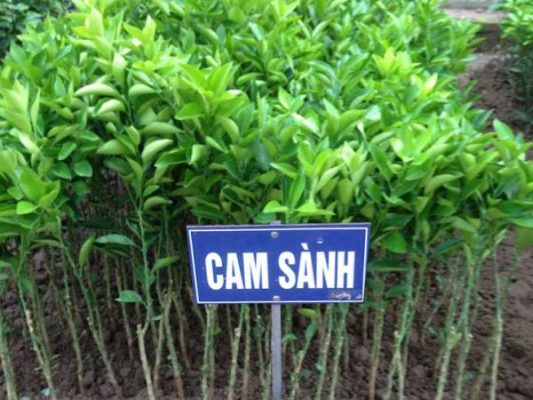
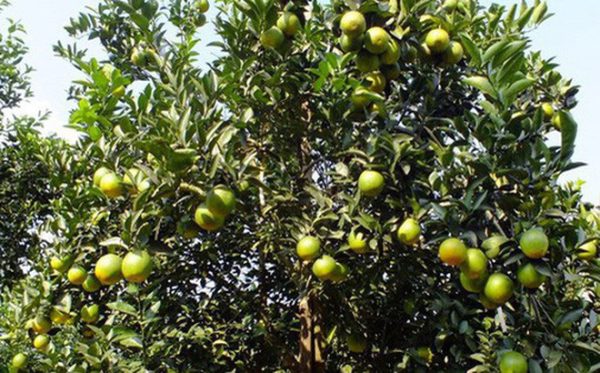
(Note: Other citrus varieties available for reference include Xoan, V2, Huong Son Buu, Sành, Canh, Lemon, and Vinh oranges).
Price: 100,000 VND per sapling.
Discounts apply for bulk purchases.
Agricultural engineering support and consulting available.
 Zalo
Zalo