HOTLINE: 0908 340 239
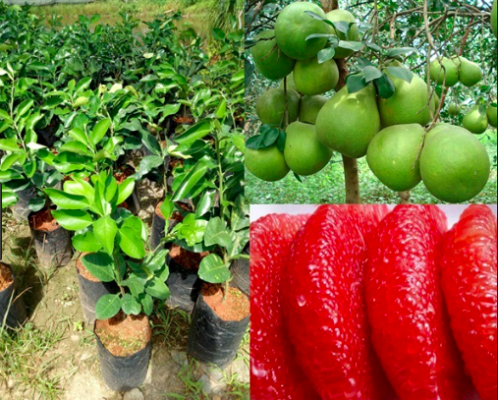
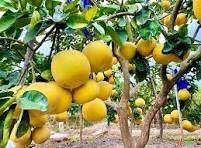
A quick online search for keywords such as "Ruby pomelo" or "Ruby pomelo saplings for sale" reveals various names like Thai fragrant pomelo, Thai red pomelo, and Thai red-flesh Ruby pomelo. The image search results can be genuinely confusing, displaying a wide range of fruit appearances: red skin with red flesh, yellow skin with red flesh, green skin with pinkish-peach flesh, and yellow skin with yellow flesh.
So, what are the true appearance and characteristics of the Ruby pomelo we expect to find?
According to nursery descriptions, the Ruby pomelo originates from Thailand. Depending on its fruit attributes and origin, the tree goes by various names such as Thai fragrant pomelo, Thai red pomelo, and Thai Ruby pomelo—with "Thai red Ruby pomelo" optimally combining all product traits.
The Thai red Ruby pomelo has been cultivated in Vietnam over the past 2 to 3 years, thriving in ecological and climatic conditions similar to Thailand. Compared to other pomelo lines, the Thai red Ruby pomelo features a much more vibrant red color and contains higher nutrients and vitamins than white-segment pomelos. Beyond the general health benefits of pomelos, it delivers a distinct aroma, an intensely sweet flavor, green skin, juicy red segments, along with excellent weight-loss and anti-aging properties.
To clear up confusion, two primary visual highlights define the authentic Ruby pomelo:
Skin Color: The skin remains a deep, vibrant green all the way until it is fully ripe.
Flesh Color: The inner segments possess a striking, deep red color.
Distinguishing Features:
Compared to Green-Skinned Pomelo (Bưởi Da Xanh): The Ruby pomelo differs by having a much deeper, vibrant red flesh.
Compared to Tan Lac and Luan Van Red Pomelos: It differs by retaining its deep green skin when ripe (whereas traditional red pomelos develop red/pinkish-yellow rinds).
Flavor & Texture: Furthermore, the Ruby pomelo features a distinct fragrance, an intensely sweet taste, large segments, and a firm texture that does not bruise or turn mushy easily.
 Zalo
Zalo