HOTLINE: 0908 340 239
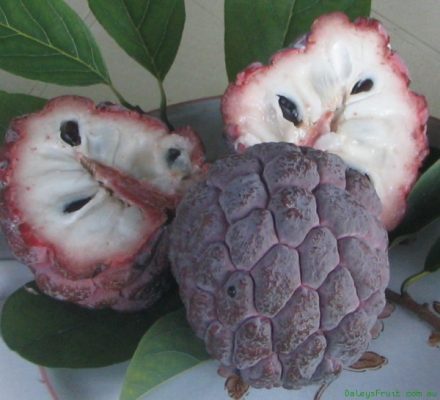
If you are already familiar with green-colored custard apples, seeing these striking purple fruits will undoubtedly surprise and intrigue you. Rest assured, this variety is completely edible and exceptionally delicious.
When first seeing purple custard apples displayed in the market, many people find them unusual because they have never encountered them before. In reality, this variety has existed in our country for a very long time, but very few people cultivated it, leading it to be nearly forgotten. It wasn't until plant conservation scientists began propagating it to restore this rare genetic resource that the purple custard apple was gradually multiplied and supplied back to the market.
Tree Structure: The purple custard apple is a woody tree reaching an average height of about 3.5 meters. It exhibits vigorous growth with a fairly wide canopy.
Distinctive Features: Unlike regular custard apples, the purple variety features darker-colored bark and more brittle branches. Its leaves are larger and longer than those of common custard apples, and the flowers bloom into a lovely white color.
Fruit Development: Trees flower around early summer, and fruits ripen two months later. When young, purple custard apples are green, but as they grow, the green color gradually fades and purple emerges. The larger the fruit, the deeper the purple hue.
Fruit Quality: The outer skin is relatively thick, while the inner flesh is pulpy, fragrant, and sweet, rivaling any other custard apple variety.
Economic Value: One reason many favor purple custard apples is their high yield. The trees suffer from few pests and diseases and produce consistent harvests year after year. Consequently, market prices for purple custard apples are much higher than those of regular varieties, bringing significant economic returns to growers.
Because it is a newly restored variety, gardeners need to understand specific knowledge and growth habits to ensure high productivity:
Climate Preferences: Purple custard apples love sunlight and dislike excessively cold temperatures. Plant them in well-ventilated, sunny locations.
Water Relations: As a tropical plant, it has poor waterlogging tolerance but good drought resistance.
Flowering Control: To induce flowers and fruits on demand, growers must prune branches and restrict water ("xiết nước") to stimulate new shoot growth.
Soil Standards: Prefers nutrient-rich, loose, and porous soils. Sandy loam with a light mechanical composition and a pH of 5.5 to 7 is ideal.
Seedling Standards: Currently propagated through air-layering or grafting by scientists, ensuring young saplings fully inherit the traits of the parent tree. Choose healthy, disease-free saplings.
Planting Season: In the North, plant around February to March annually. In the South, plant during the rainy season.
Planting Method: Clean the land and dig planting holes at least 3m apart, with minimum dimensions of 50x50x50 cm. Apply basal fertilizer to the soil: 10kg of decomposed chicken manure, 0.5kg of Superphosphate, and agricultural lime for disinfection. Plant gently to avoid breaking the root system, set the sapling straight, pack the soil firmly around it, and water immediately to help roots establish.
Watering: Keep the soil consistently moist for newly planted trees. Once established, water every 2–3 days. Increase watering during the dry season and mulch with straw around the base to prevent evaporation.
Fertilization:
For trees aged 1–3 years: Apply annually 1kg of farmyard manure, 1kg of NPK, and a quantity of Superphosphate (plus optional leaf growth stimulants during early stages).
For trees aged 4–7 years: Apply 20kg of farmyard manure and 1.5kg of NPK (15:7:6) per year.
Purple custard apples have a relatively quick turnaround time, yielding fruit just 15 to 18 months after planting. When ripe, the fruit's segments widen and display a stunning purple color. Harvest in the early morning when it is not raining for the best fruit quality. Pick them when they are just ripe and still firm, leaving them for a few days to soften before consumption.
 Zalo
Zalo