HOTLINE: 0908 340 239
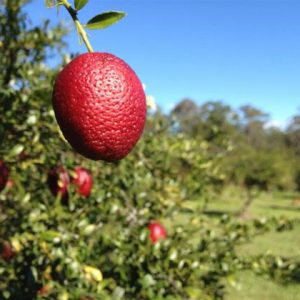
Unlike the ordinary colors of their relatives, this one-of-a-kind citrus fruit boasts an impressive color along with an equally special name: Red Lime or Blood Lime. The red lime tree is considered a rare, world-famous specialty citrus of Australia. For a long time, this fruit has been the pride of the local people and is cultivated over very large areas spanning hundreds of hectares.
According to various documents, this red lime variety is a cross between the special red finger lime and a hybrid mandarin variety. Therefore, they are considered to inherit all the characteristic traits of these two fruits: a distinctive red color and a sweet, delicious flavor like that of a mandarin.
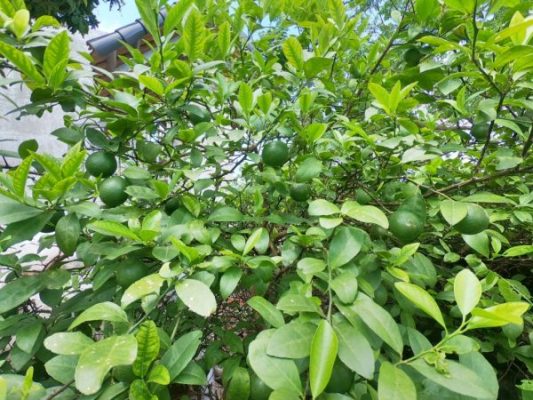
The red lime tree has a well-developed canopy. A mature tree reaches a height of about 6-8 meters. The canopy is wide with long, glossy leaves. The red lime tree typically blooms around July. Its flowers are purple on the inside and white when blooming, emitting a quite pleasant fragrance. Red limes are elongated in shape and generally larger than common limes. The thick, glossy skin is green when young and gradually turns to purplish-red as it matures.
Besides being delicious, the tree has a rather attractive shape, making it popular for ornamental planting as well as fruit production. Another characteristic is that when grown under favorable conditions, the tree yields an abundant crop. It truly lives up to its reputation as a specialty fruit of the Australian people.
The red lime tree is evaluated as having fairly good vitality. It prefers sunlight and locations with high soil moisture. Flowering and fruiting occur just 12 months after planting.
Seedling Selection Standards: Currently, red limes are mainly propagated by grafting because it ensures quicker harvesting and more uniform, beautiful fruits. It is necessary to select grafted saplings that are about 50cm or taller with all plant parts intact. The seedlings must be healthy and free of pests and diseases.
Planting Season and Density: In our country, red limes are best planted around July or during the rainy season to minimize the effort required for watering. When planting limes, maintain a distance of at least 3 meters between trees because they possess quite spreading canopies. Note that they should be planted in locations where the ground level is raised at least 60cm above the surrounding surface.
Soil Preparation and Treatment: To grow red limes successfully, they should be planted in loose, humus-rich soil. Red limes love water but cannot tolerate waterlogging, so you need to create raised beds and drainage ditches. The planting hole dimensions should be at least 60x60x60cm. One month before planting, basal fertilization should be applied to each hole using 10kg of well-rotted manure, 0.5kg of phosphate fertilizer, and agricultural lime for disinfection.
Planting Technique: One month after applying basal fertilizer to each hole, proceed to plant the saplings. Dig a small hole in the center matching the size of the root ball, then gently place the root ball inside. Fill in the soil tightly around the base and firm it with your hands to keep the plant in an upright position. You can stake the young sapling with bamboo sticks initially to prevent it from toppling over. Water immediately after planting to provide moisture and help the plant take root quickly.
Watering Regime: The red lime tree loves moisture, so it requires an adequate water supply to thrive. Pay attention to watering during the dry season, as well as during the flowering and fruiting stages.
Canopy Shaping for Red Lime Trees: The red lime tree develops an extensive canopy system. Therefore, during the first two years, you should periodically prune to remove water sprouts, withered branches, and diseased limbs. You only need to keep 3-4 strong, healthy branches per tree to nourish it. Thawing also keeps the tree well-ventilated, enhances photosynthesis, and ensures sufficient energy to nourish the fruit.
Fertilization Regime: Depending on the soil nutrient levels and the health condition of the tree, the fertilization schedule varies. In addition to the initial basal fertilization, you should periodically apply top-dressing fertilizer about twice a year. For each application, apply about 10kg of manure and 0.5kg of NPK fertilizer (16-16-8) per root. In subsequent years, increase the fertilizer amount by 10% annually. In years with heavy harvests, increase the fertilizer amount further to help the tree recover quickly.
Weed Control: Alongside fertilization and watering, you should periodically clear weeds to keep the base area well-ventilated and prevent them from competing for nutrients with the tree. Cultivate and loosen the soil around the base twice a year.
Pest and Disease Management: Red limes are quite hardy and rarely suffer from pests and diseases. The only potential pest and disease threats are citrus psyllids, red spider mites, and root rot. Regularly inspect the lime orchard to promptly detect abnormal signs and take immediate action through spraying or manual removal.
About 12 months after planting limes, you can enjoy your first harvest of delicious and attractive red limes. Mature red limes reach a size of about 3-5cm in diameter and have an elongated shape. Once fully ripe and the color shifts to a deep red, they are ready for harvest. After picking, store them in a cool, dry place where they can remain fresh for a very long time.
 Zalo
Zalo