HOTLINE: 0908 340 239
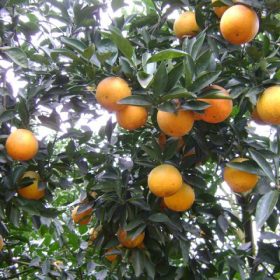
Stunning American yellow oranges have recently appeared on the market, captivating many people. Not only do they boast an outstanding appearance with a brilliant golden hue, but this orange variety is also listed among the most nutrient-dense fruits in the world.
In recent times, the Vietnamese market has welcomed quite a few exotic fruit varieties originating from abroad. Among them, the American yellow orange stands out. With its beautiful, large size, enticing aroma, and intensely sweet taste, it makes many people fall in love at first bite.
This is the most famous Navel orange variety in the United States. According to historical records, this variety was discovered as a natural mutation in a Brazilian orchard in 1820. Since the discovery of this delicious and exotic orange, local people have propagated it worldwide. Today, this variety is most extensively cultivated in California, Florida, and Texas.
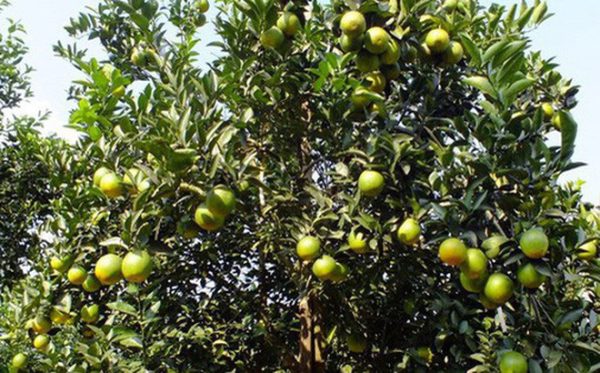
The tree reaches an average height of about 4 meters. Despite its modest height, its foliage and canopy are quite well-developed. The leaves are quite large, elongated, and dark green. When in bloom, the flowers are quite attractive, white in color, and typically grow in clusters of 3 to 4.
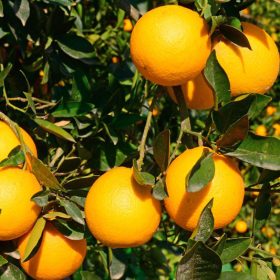
The most appealing feature of the American yellow orange is its fruit. Unlike native orange varieties, which are slightly flattened spheres, American yellow oranges are quite round and large. They feature a smooth, glossy, beautiful golden-orange rind. Beyond its gorgeous exterior, when sliced open, the inside reveals a bright yellow pulp with a sweet flavor and a distinctive aroma.
American yellow oranges weigh an average of 250 grams per fruit. Furthermore, the trees bear heavy crops and fruit quickly, holding high promise as an economically valuable crop.
Not only does it possess an eye-catching appearance, but research also shows that American yellow oranges contain numerous health-beneficial nutrients. First is the abundant Vitamin C content, which promotes healthy skin, rapid wound healing, and enhanced immunity. Additionally, the fiber and cellulose content benefit the digestive system, stimulate intestinal peristalsis, and lower harmful cholesterol levels in the body. People who regularly consume American yellow oranges enjoy smooth, radiant skin and boosted immunity, thereby falling sick less frequently.
American yellow oranges are typically planted in autumn. At this time, temperatures are no longer excessively hot, making it ideal for the growth and development of the trees.
American yellow orange trees love sunlight, so the planting site must receive abundant sunlight—at least 6 hours of direct sunlight daily. The soil must drain well and be located away from overgrown weed areas and construction zones.
Before planting, prepare the soil thoroughly by pulling out weeds and plowing to loosen the soil, helping the trees develop well later. Dig a hole in the garden with dimensions of 40 x 40 x 50 cm. Apply a basal dressing of well-rotted manure and agricultural lime to disinfect the soil, making it cleaner and richer in nutrients.
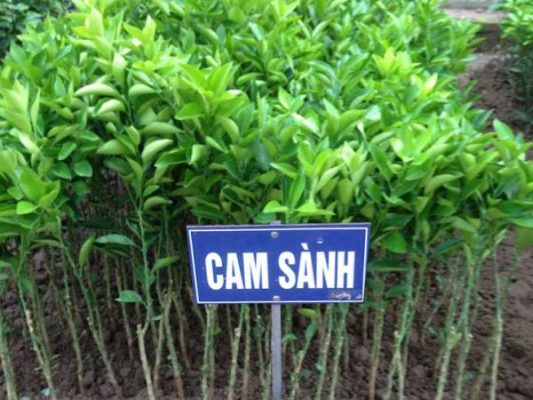
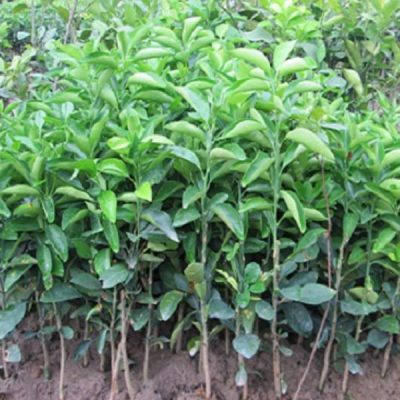
American yellow orange saplings are widely sold on the market today. Because it is a low-seed variety, propagation from seeds is impractical. Therefore, American yellow oranges are currently propagated via air-layering or grafting. The saplings will inherit all the exact traits of the mother tree.
When planting, handle the sapling gently to avoid breaking its roots. Remove the nylon bag enclosing the root ball, then place the sapling upright into the planting hole. Fill in the soil to cover the surface, then press down firmly with your hands to secure the trunk.
Water the tree immediately after planting to help the roots take hold. Maintain soil moisture for 1 month post-planting. Note that in windy or stormy regions, staking with a pole is necessary during the initial stages.
Being a temperate fruit variety, American yellow oranges have moderate water requirements. Water the trees regularly once every 3 days. Critical times requiring increased water supplementation include the fruiting stage and the dry season.
American yellow orange trees are quite sensitive to changes in soil conditions. They grow slowly when surrounded by weeds or when planted near industrial facilities. Therefore, periodic weeding and soil cultivation around the trees are essential.
American yellow oranges have a low average height and a wide-spreading canopy. Consequently, pruning and shaping are necessary to encourage heavier fruit production.
Once the tree reaches a height of 1.5 meters or more, prune the branches to develop primary framework branches (Level 1). Each tree only needs 3 to 4 main branches. For each main branch, pinch the tip to produce 2 secondary branch shoots (Level 2). Continue this pattern to create Level 3 branches, helping the tree form a rounded, spreading canopy.
To ensure large and sweet fruits, fertilization is essential. Adjust fertilizer rates based on tree age and soil nutrient composition.
First year: This is the phase for branch and leaf development to establish the canopy framework. Apply NPK 15:15:15 fertilizer periodically every 3 months, at about 1 kg per base per application. Additionally, apply leaf- and branch-stimulating fertilizers.
Second year onward: The tree has grown taller and is preparing for its first fruit yield. Apply fertilizer twice a year, at the beginning and end of the year. Increase the annual fertilizer amount by 20%.
Because American yellow oranges are a temperate crop, cultivation in our country inevitably encounters certain pests and diseases. Typical issues include fruit borers, leaf-eating caterpillars, and root rot.
Root rot: Prevented by keeping the soil well-aerated and loose. Periodically cultivate the soil, pull weeds, and prevent waterlogging during the rainy season. Whitewashing the trunks with lime helps restrict harmful bacteria causing root rot.
Fruit and leaf borers: Regularly monitor the field and inspect leaves and fruits during the fruiting stage to detect pathogens early. Spray a uniform application of plant protection products twice, spaced 15 days apart, to thoroughly eliminate harmful insects.
When cultivated in Vietnam, American yellow oranges begin yielding regular harvests from the third year onward. When ripe, the fruit turns a radiant golden color, feels large, tight, and heavy in hand, and releases a fragrance that fills the orchard. Gradually harvest the largest fruits first until finished. Store the harvested fruits in a cool, ventilated place to keep them fresh longer.
 Zalo
Zalo